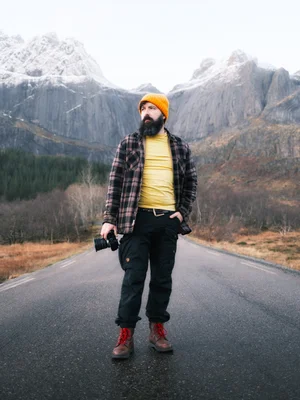
Senja Photography: Chasing Light on Norway's Quiet Alternative to Lofoten
Here's the thing nobody puts on the postcard. In November, Senja (roughly "SEN-ya", though I wouldn't swear to it in front of a Norwegian) hands you about seven hours of daylight, and a fair chunk of that is the sun thinking about whether it can be bothered to clear the mountains at all. Sundown at 3pm. Sunrise whenever it fancies. Flat, grey, and frankly a bit miserable for a good portion of our visit.
Senja photography: the quick version
Where: Senja, northern Norway (Troms), the big island just north of Lofoten
Getting there: Fly into Tromsø, hire a car, then a short ferry or a drive round. A car is essential.
When we went: November. Roughly seven hours of daylight, sundown by 3pm, moody winter light and aurora on the cards.
Best photo spots: Tungeneset, Hamn i Senja, the Bergsbotn viewing platform, and Segla (shot from Hesten)
The big hike: Hesten for the classic Segla view. Around 2km uphill, mostly mud and ice in winter, microspikes worth carrying.
In the bag: Sony A7R V, 16-35mm, 50-400mm, 24-70mm, DJI Air 3 drone, polariser and ND filters, plus the Fujifilm X100VI for off-duty wanders
Worth knowing: Far quieter than Lofoten for a similar amount of drama. That's the whole pitch.
Getting to Senja
We flew into Tromsø via Oslo from London, picked up a hire car, decided to try 1 hour drive to the ferry rather than the longer drive round, found a shop for milk so we could actually have a cup of tea (well Cas drinks coffee…), and woke up the next morning in one of the most ridiculous landscapes I've ever had the pleasure of being in.
Most people heading this far north point the car straight at Lofoten. We did too, eventually. That's the next post. But first we spent a few days on the island everyone seems to drive past, and I'm genuinely not sure why they do. So if you're planning your own trip and weighing up the spots, here's where I pointed the camera, what worked, what very much did not, and the story of unpredictable light in off season Senja.
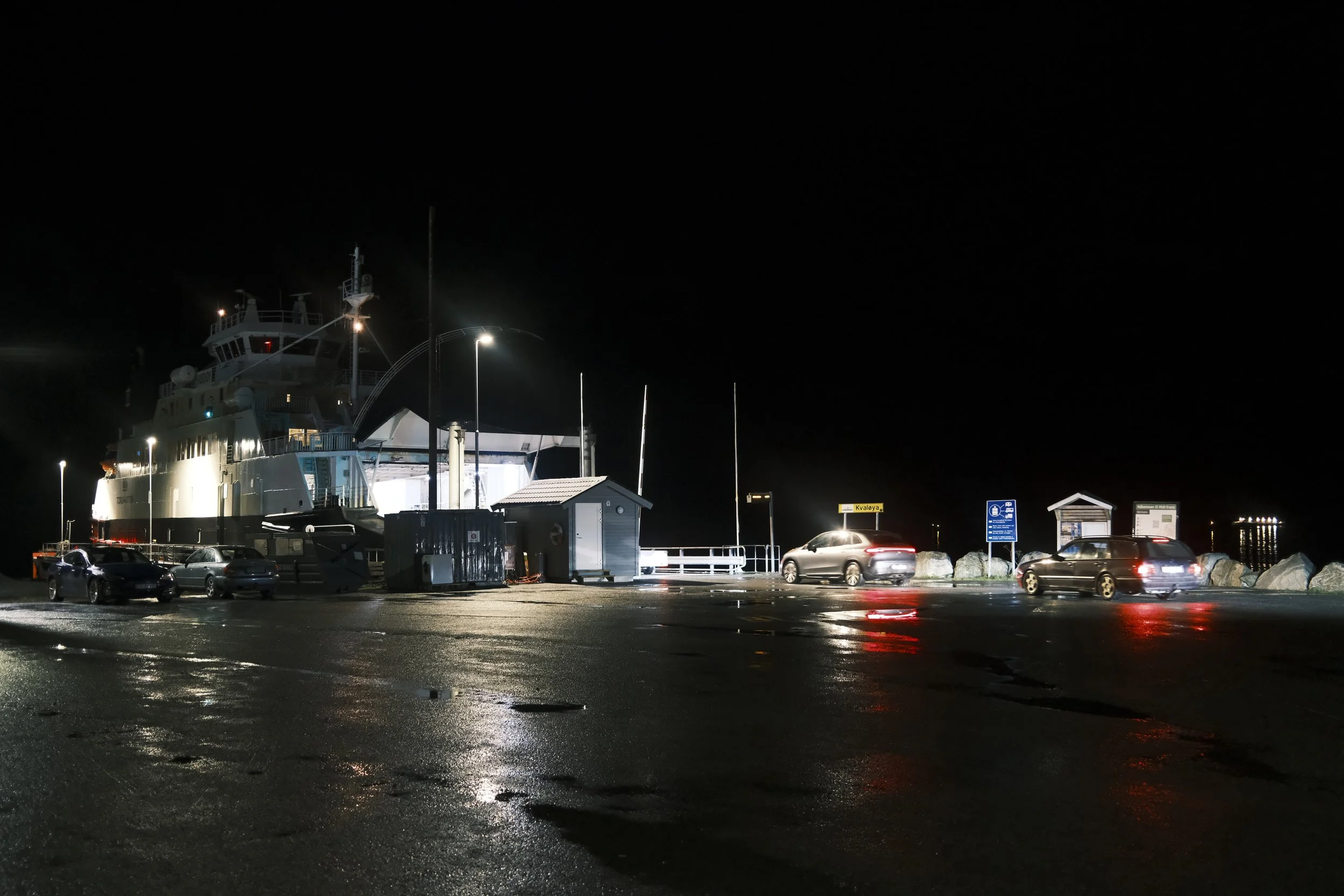
Getting off the ferry after a long day of travelling: Botnhamn, Senja
Tungeneset: rock pools, jagged peaks, and a lens hood sacrifice
Tungeneset (one of many place names I struggled to pronounce on this adventure) is the one you've probably seen. A short walk out over wet black rock to a foreground of pools and channels, with the Okshornan ridge, "the Devil's Teeth", stacked up behind. Car park's right there, the walk is nothing, and it is rightly busy with photographers. As you'd expect in a place this good-looking.
The light wasn't playing. Lovely sky, but a bank of cloud sitting on the horizon meant nothing was coming over to light the peaks. Flat it is, then. You take what you're given.
So this becomes a composition problem rather than a light one, which is no bad thing for learning. The instinct is to go wide and shoot across the rock pools, but there's a lot of dead sea sitting between the foreground and the mountains. The fix is to get low and tilt down slightly. Drop the camera, pick a 16mm or thereabouts, and you pull the foreground and background closer together, lose the empty mid-ground, and let those wet channels run as leading lines straight towards the Devil's Teeth. Wide enough to keep all that brooding sky, low enough that the rocks do the work.
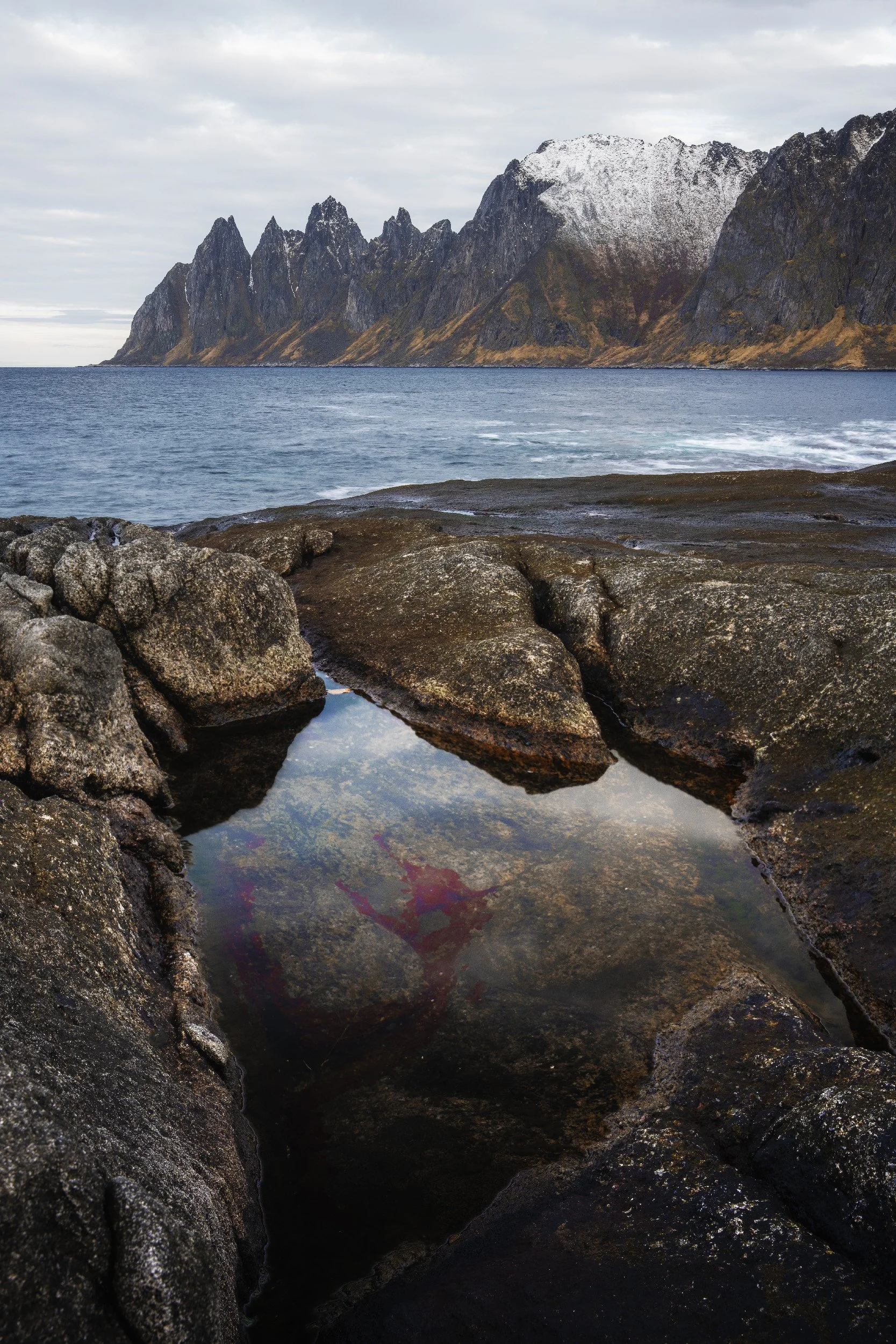
Tungeneset Rock Pools
Word of warning on the rocks. They are slippery, several of them are properly black and wet, and within roughly ninety seconds of arriving, Cas had dropped her lens hood. It rolled all the way down into a rock pool. We fished it out, then promptly lost a magnet off the back of my DJI mic, it rolled into a crevice underneath a massive boulder. Day one and we're already haemorrhaging kit... Luckily my DJI 360 selfie stick has a magnetic end, which we used to retrieve the mic magnet.
Some photographic equipment was harmed in the making of this trip, and it started here. Mind your footing, and maybe don't bring anything you can't afford to feed to the Norwegian Sea.
Taking to the air for a different perspective
It was time to get the drone out. Being off-season, the area was relatively quiet allowing me to get my drone up. The fjords and surrounding landscape seemed like they could be worth exploring from above, and I was right. Probably my favourite image from this roadside stop came from the DJI Air 3.
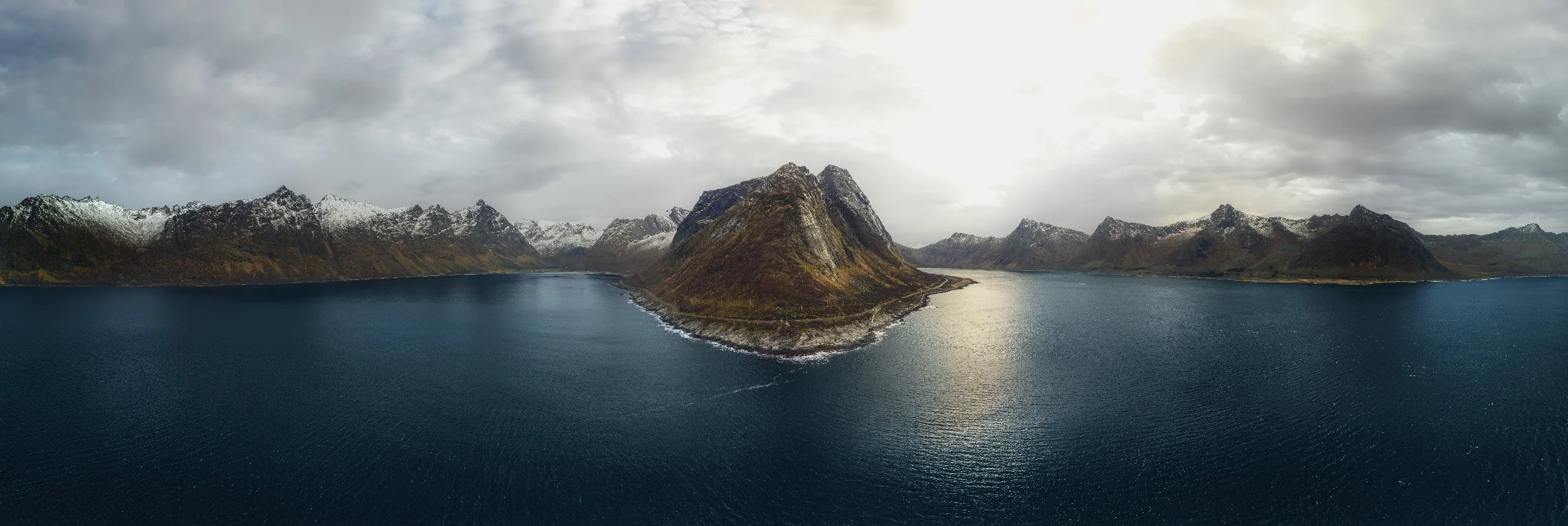
180 Degree Panorama looking back towards Tungeneset
The rocks jutting out in the centre of the frame is where we were stood. Mostly shooting towards the ‘devils teeth’ which is comprised of the mountains running out on the left of the frame. Some nice symmetry, but the edit is doing the heavy lifting here due to the relatively flat light.

Heading to Lofoten next?
The Lofoten Photography Guide
Skip the wrong turns I made. Seventeen locations mapped north to south down the E10, with the light, the compositions and the honest logistics for each. Instant PDF, £16.99.
The roadside huts are everywhere!
Senja is one of those places where the gaps between the famous spots are half the point. Drive almost anywhere and you'll pass little red fjord-side huts with absurd mountains behind them, and you will stop, because you have to. It's a compulsion. Submit to it.
This is also where I'll happily show you one I got wrong, because that's more useful than pretending everything came off. I framed up a pair of huts with white doors, nice grasses in the foreground, decent light finally creeping in. Looked great in my head. But the doors, the bit of the building that draws your eye, were facing out of the frame, which quietly walks the viewer's attention straight off the edge of the photo. Naff. On a near-identical hut down the road with red doors facing inward, the same composition suddenly works, because now the building points you back into the scene and those big peaks behind it. Lesson logged: it isn't just where things are in the frame, it's which way they're pointing.
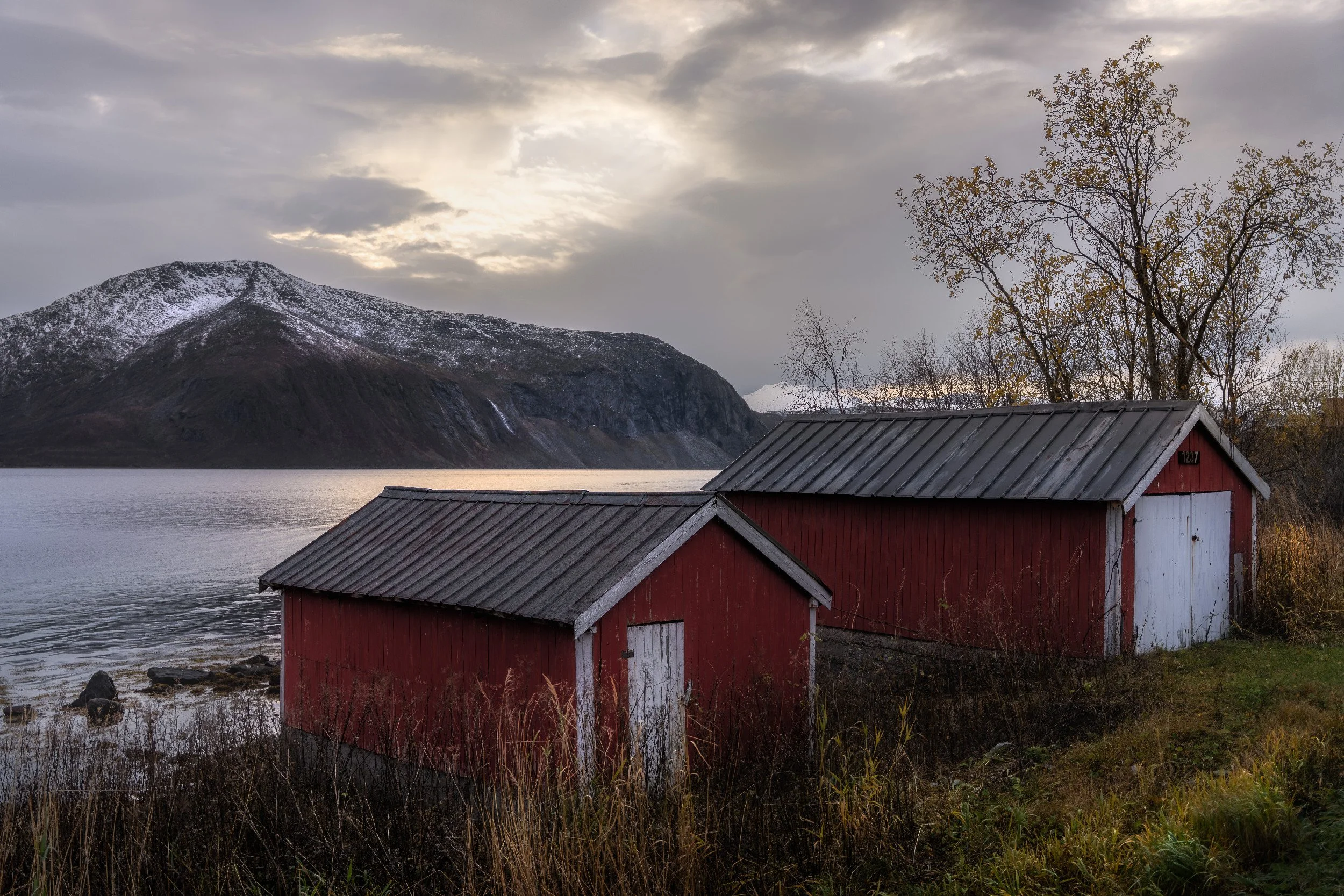
The huts pointing out of frame causes tension, not the idea for this photo
And when you genuinely can't make it work? Shoot it straight on, dead central, and let symmetry bail you out. It nearly always does.
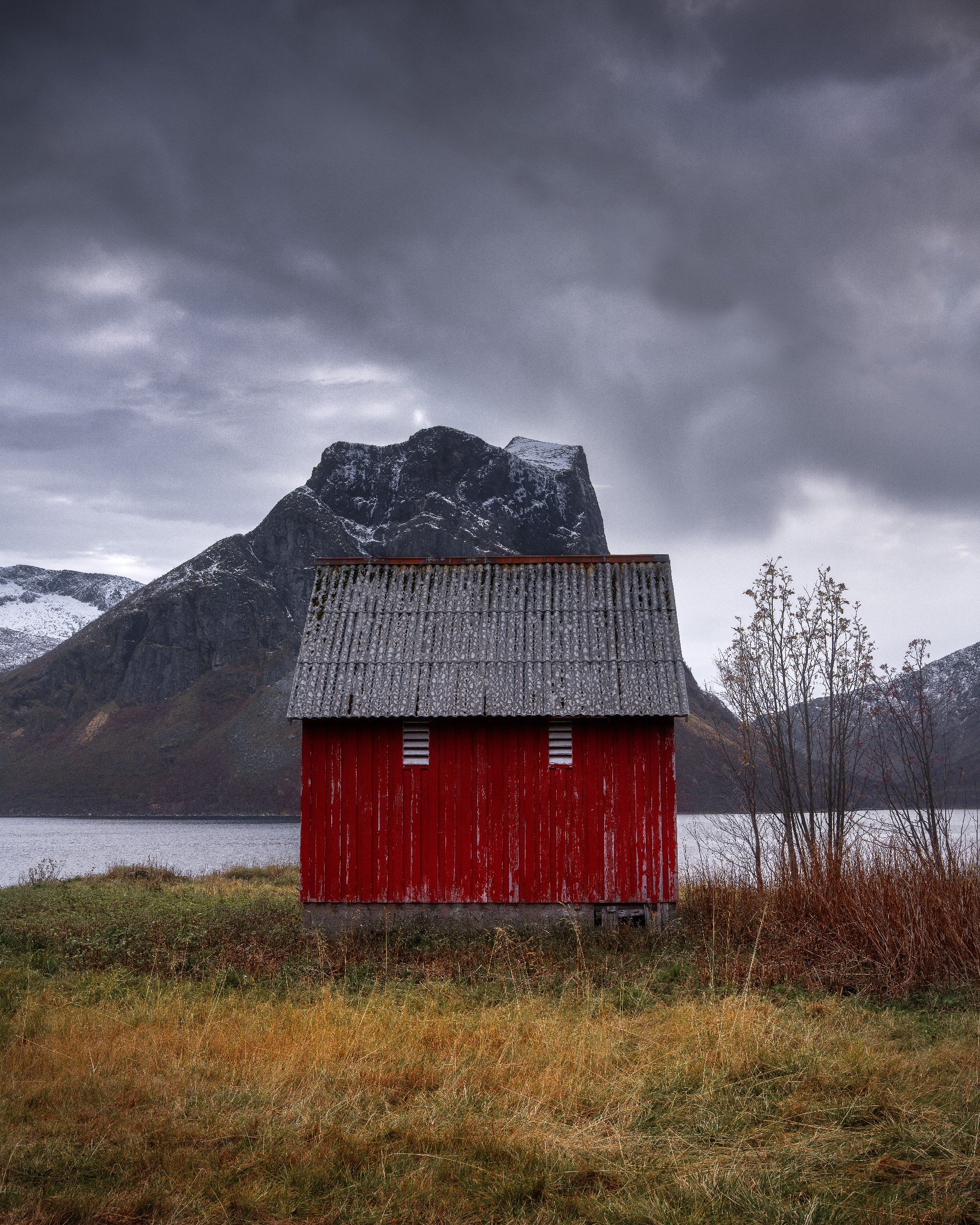
Red huts along the roadside at Bergsbotn
Hamn i Senja: postcard-quiet and almost too pretty
I found Hamn i Senja (Hamn, with an N, as I kept reminding myself) on Google Maps, pinned it as a maybe, and it turned out to be one of the best stops of the whole island. Little islands trailing out into the fjord, some with houses on them, joined by these lovely small bridges. A red boat, which I wish was on the water but nonetheless added a splash of colour. An epic backdrop. And so, so quiet. We had it almost to ourselves.
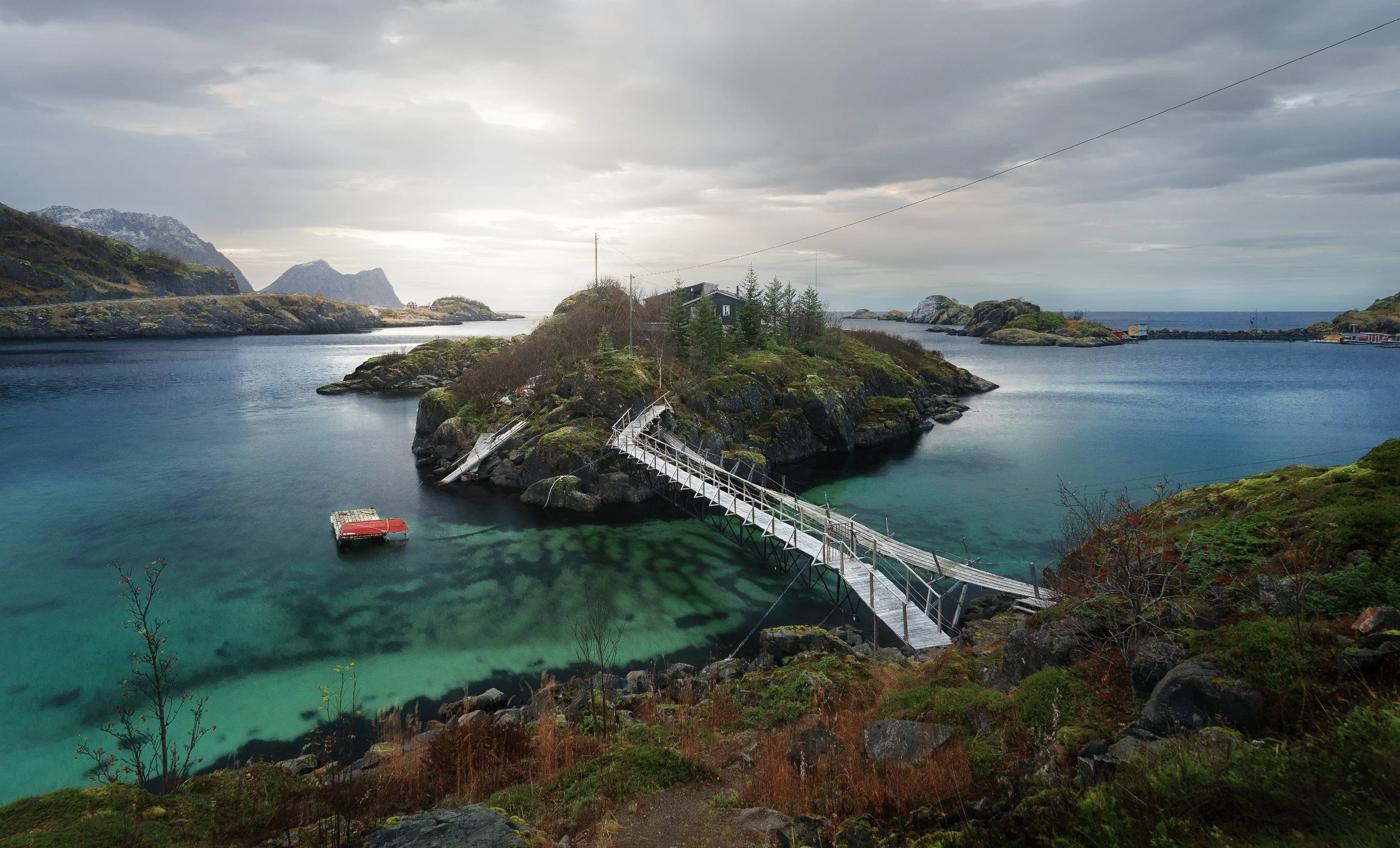
An Island paradise - Hamn, Senja
The light still wasn't optimal, clouds doing their best to smother the sunset, but this is a location that doesn't really need a sky on fire to deliver. Two things earned their place in the bag here. An ND filter to flatten the fjord into something glassy, and a polariser to cut through the surface reflections, because there were beautiful patterns under the water that you'd otherwise never see.
Once I'd worked the shots from the roadside, the drone went up on its third and final battery of the day to grab the whole sprawl of islands from above, which is really the only way to read how the place is laid out.
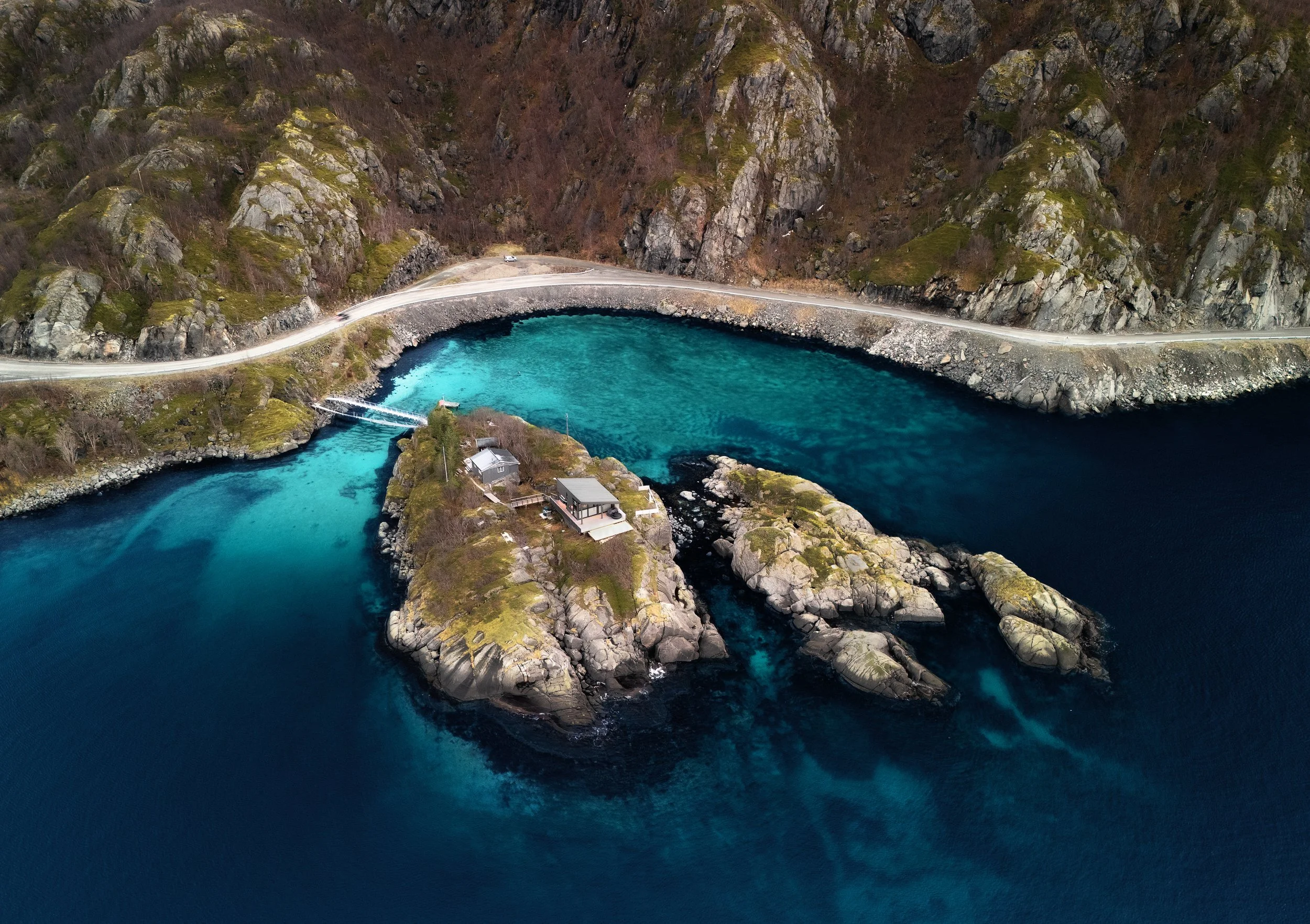
Beautiful water and Islands of Hamn, Senja
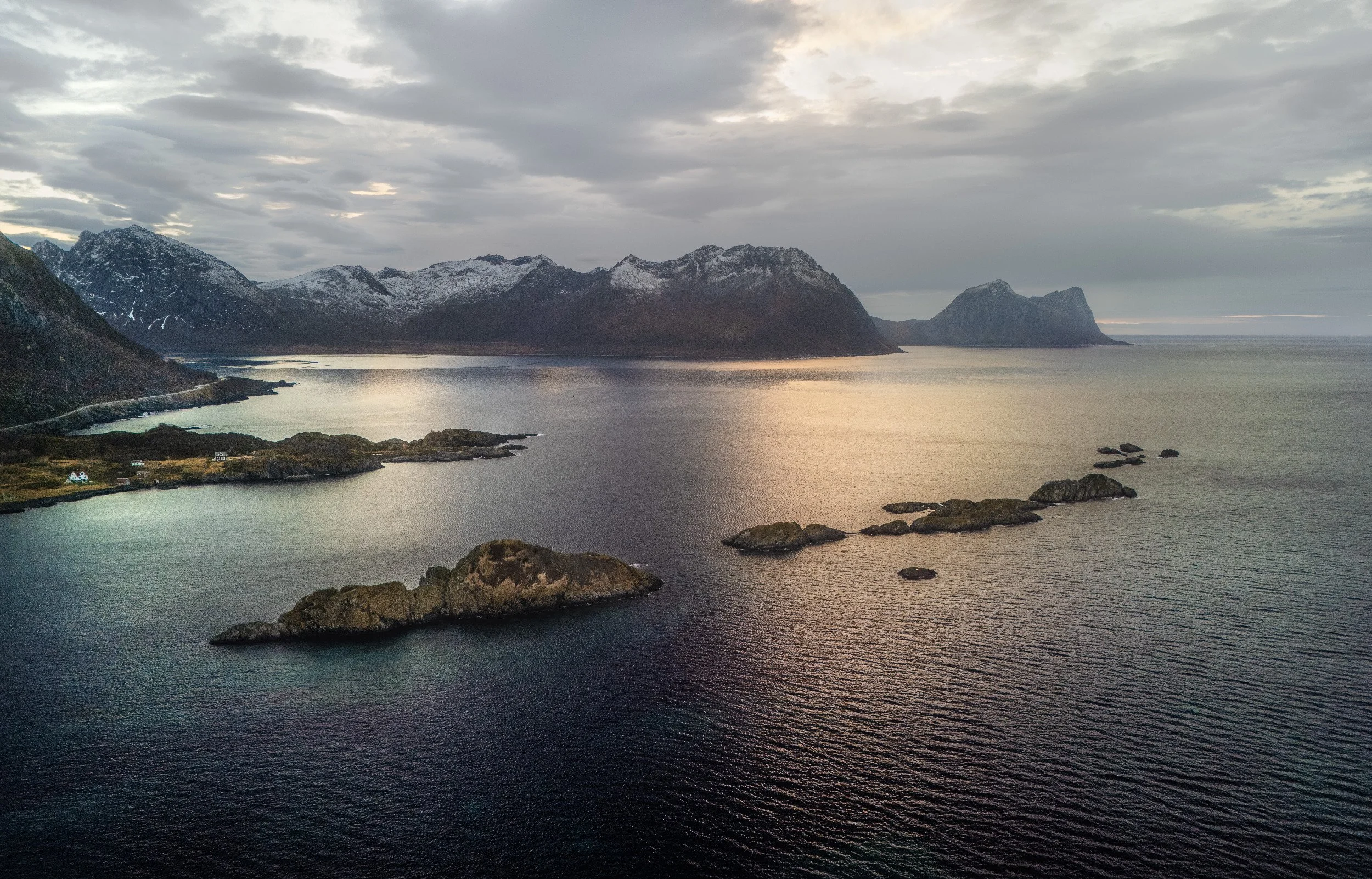
View North West with Hamn village Behind
A polariser in soft light is one of the cheapest upgrades to a fjord shot there is. Bring one.
Bergsbotn: the platform viewpoint worth the small detour
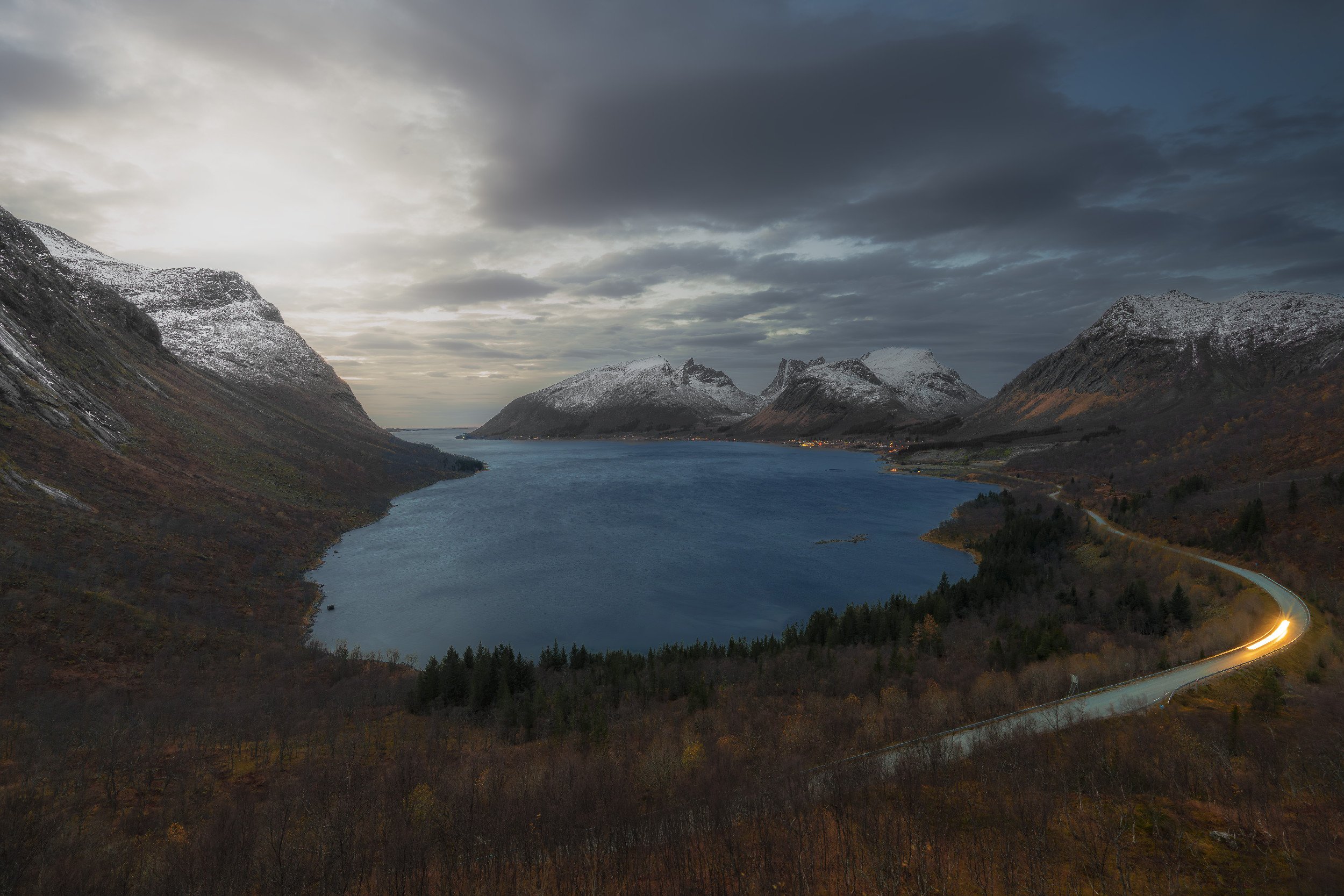
On the way back we stopped at the Bergsbotn (Bergsbotn) viewing platform, a little cantilevered deck that juts out over the fjord and lets you look straight back down the water towards the mountains. It's a roadside job, no effort required, and a useful one to have in your back pocket for golden hour if the timing lands. It didn't quite for us, the high cloud only lighting up behind the peaks rather than on them, but where there's a will there's a way, and I still came away with a few I was happy with. File it under "stop if you're passing, and you will be passing."
Chasing the northern lights over Senja, badly
Right, let me set expectations. We were sat in a bay window in some rocking chairs, brew in hand, garlic bread heading for the oven, when Cas spotted the aurora kicking off over the boat house outside. Cue total chaos. Oven off, coats on, grab the batteries off charge. This is the dream, isn't it. This is why you come north.
The northern lights over Senja are genuinely on the menu in winter, and we got a cracking show. What we did not get was a single composition I’d call portfolio worthy. We started off by running outside to the garden, hoping the boathouse would provide a decent foreground and for me to hurriedly record some vlog for contents sake!
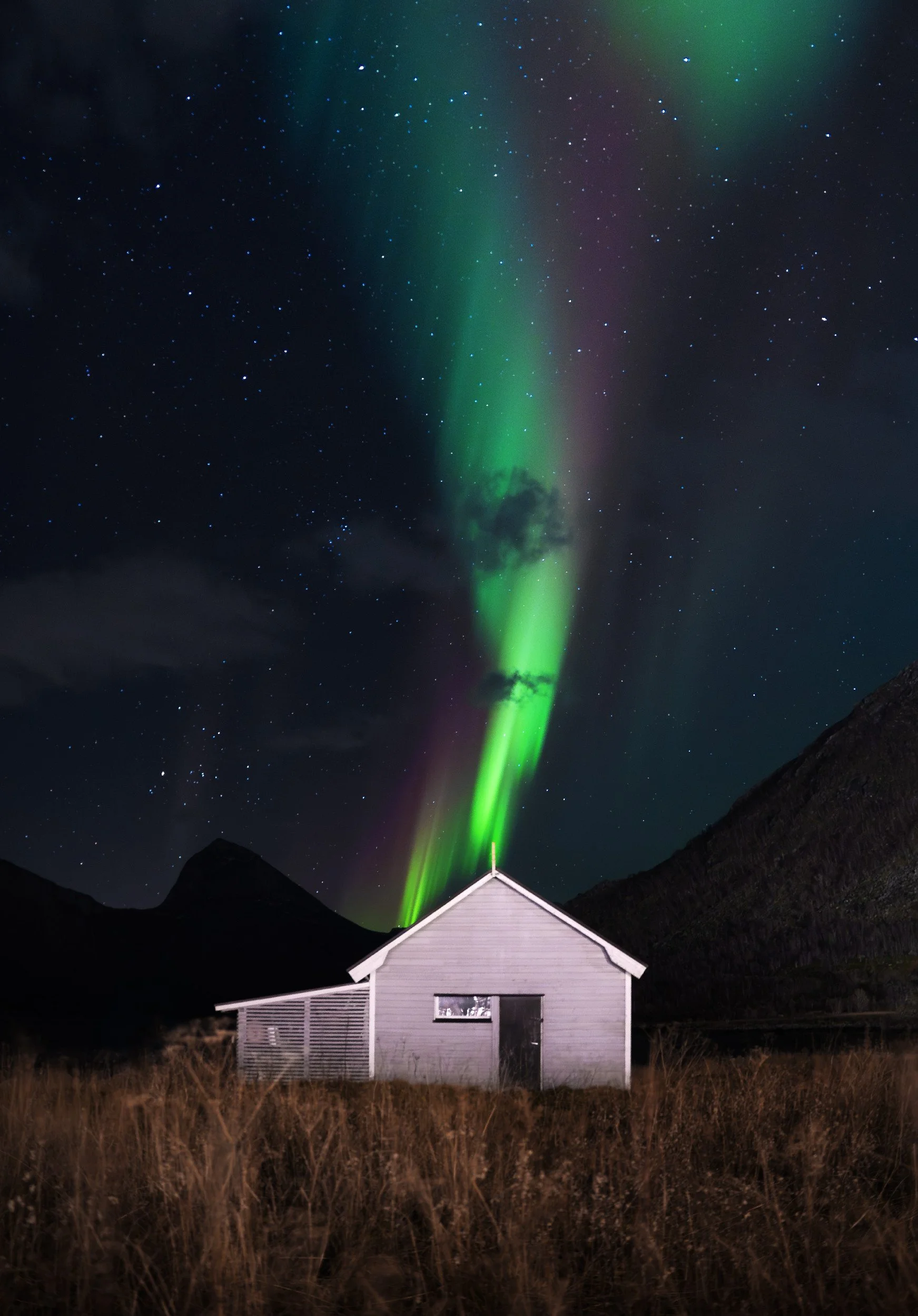
The Boathouse in front of our AirBnB, Senjahopen. With less than adequate focus!
We drove a little way out of Senjahopen hoping to escape the house/street light pollution, and then spent twenty minutes failing to find anything to put in front of the sky. Too many scrubby bushes on the roadside, the angle dropping away down towards the mountains, nothing to anchor it. I hadn't scouted a dark-sky composition because, in my defence, you don't always plan for the aurora to gatecrash your dinner. Perhaps this was an oversight!
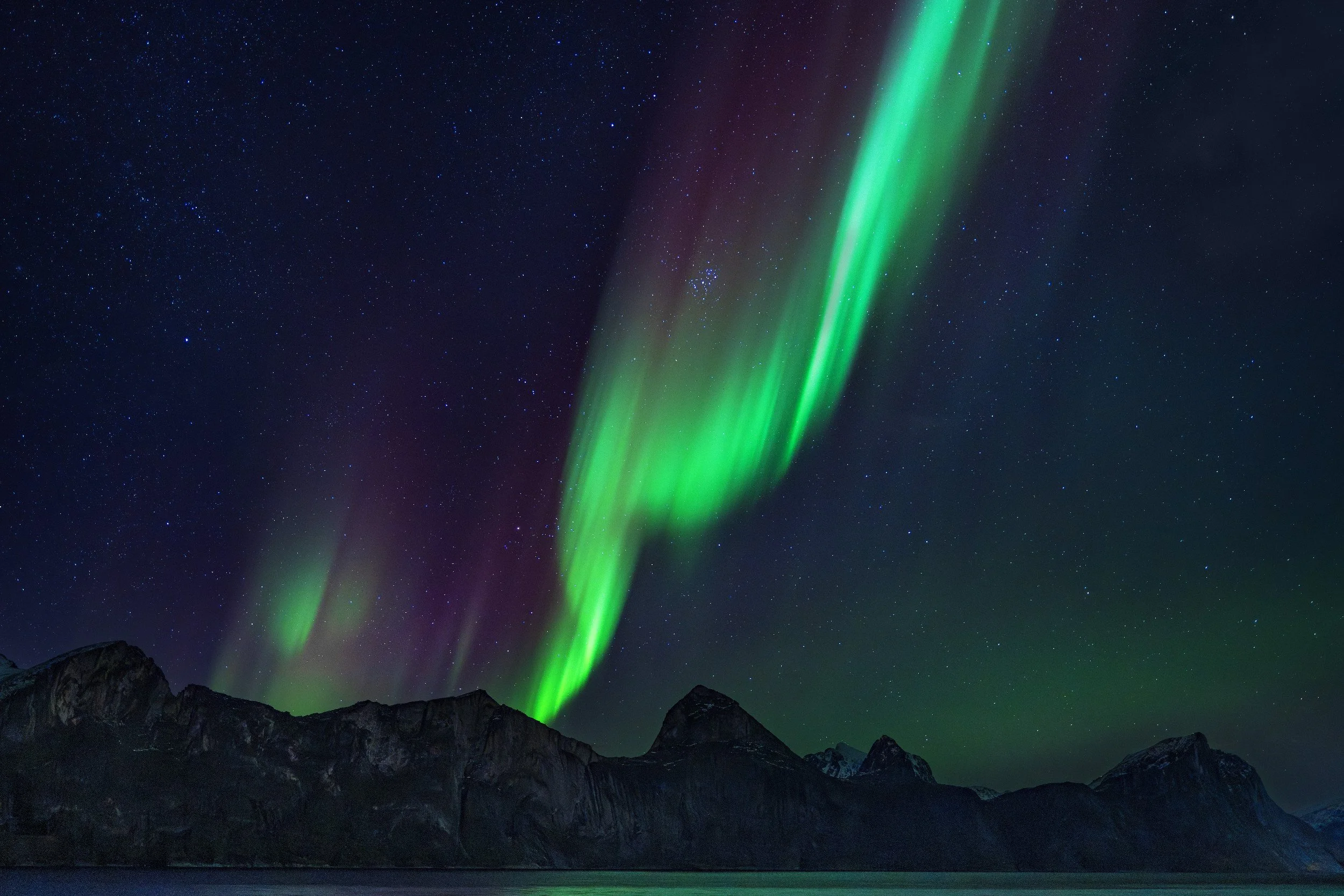
Shooting over the shrubs, this was the view back towards Segla/Hesten.
So the honest takeaway, and the one I'd actually give you: if there's any chance of aurora, scout your foreground in daylight. Pick a spot with a strong shape you can shoot towards in the pitch dark, because composing on the fly with frozen hands and no reference points is a recipe for a memory card full of "well, you had to be there."
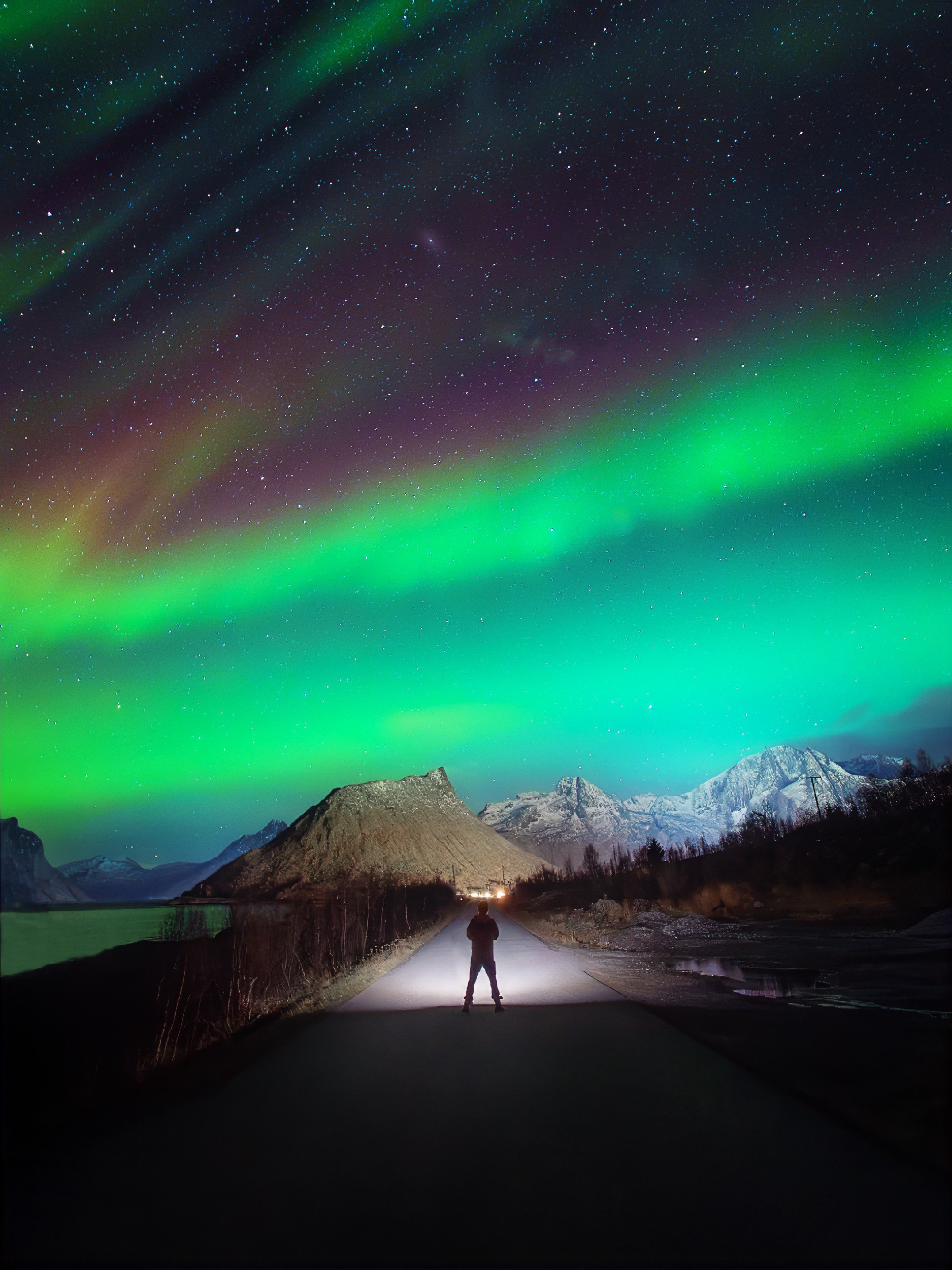
If in doubt, use a road as foreground and M31 (Andromeda) plus Aurora as a backdrop
The show was unforgettable. The photos were fine. Learn from me!
The hike up Hesten for the iconic Segla shot
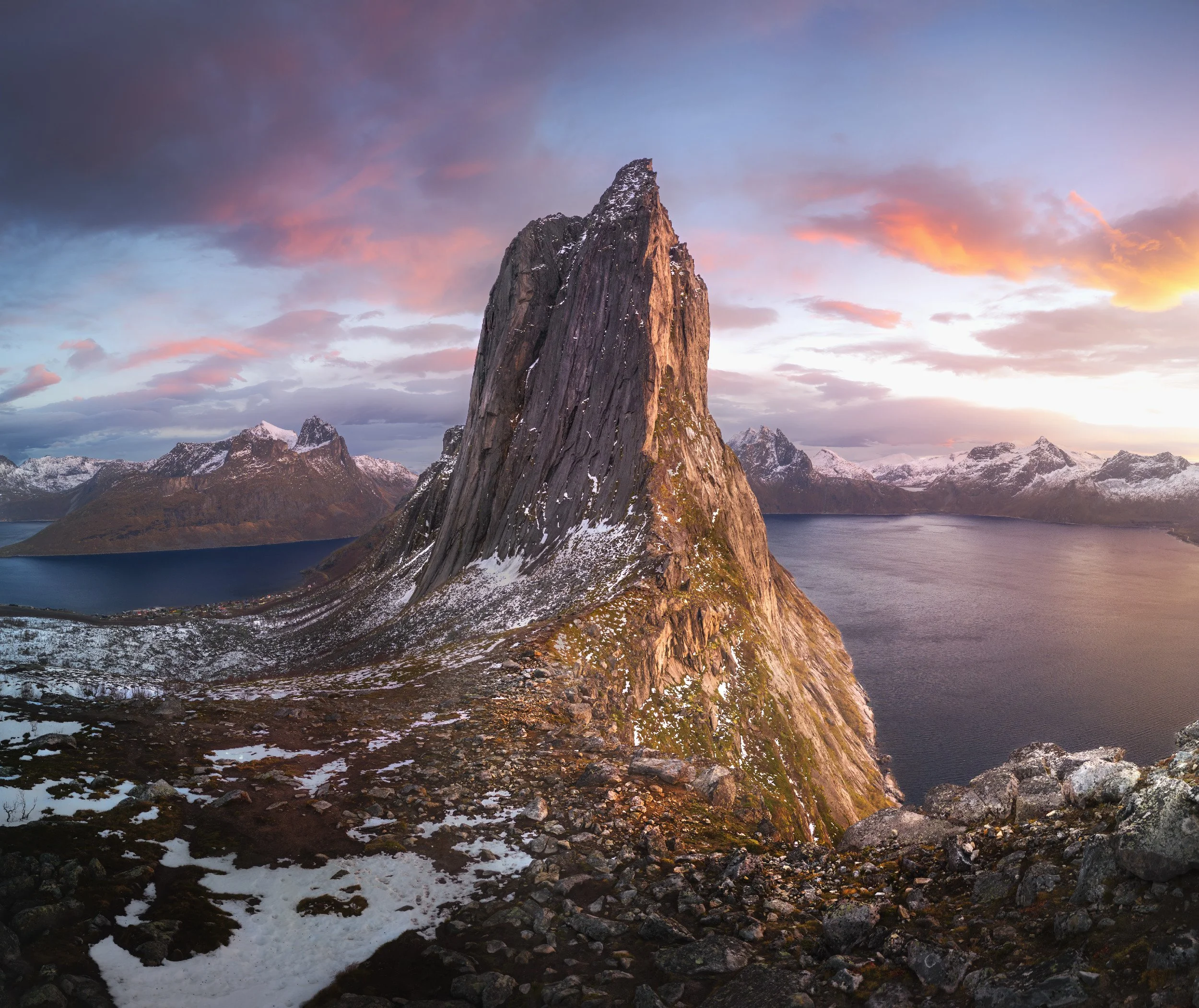
Every island has its honeypot, and on Senja it's the view of Segla (translated means "the Sail"), shot not from Segla itself but from the neighbouring peak (or close to it..), Hesten. You've got to bag the iconic shot, so up we went.
A few honest notes on the Hesten trail. It's around two kilometres, it's uphill, and you're carrying everything, which in my case was somewhere north of ten kilos, roughly fifteen percent of my bodyweight, dragged up a mountain by a man who is not as fit as he'd like you to believe.
We'd had a lie-in rather than chasing a sunrise that probably wasn't coming, and gone for the afternoon light instead. The trail was ninety percent mud and ten percent ice towards the bottom. That percentage shifting the higher we got.
The boardwalks across the boggy lower area was much welcomed. We carried micro spikes, dithered about whether it was worth putting them on, then hit a properly icy stretch and stopped pretending. Spikes on. Better a faff than a busted ankle two days into the trip.
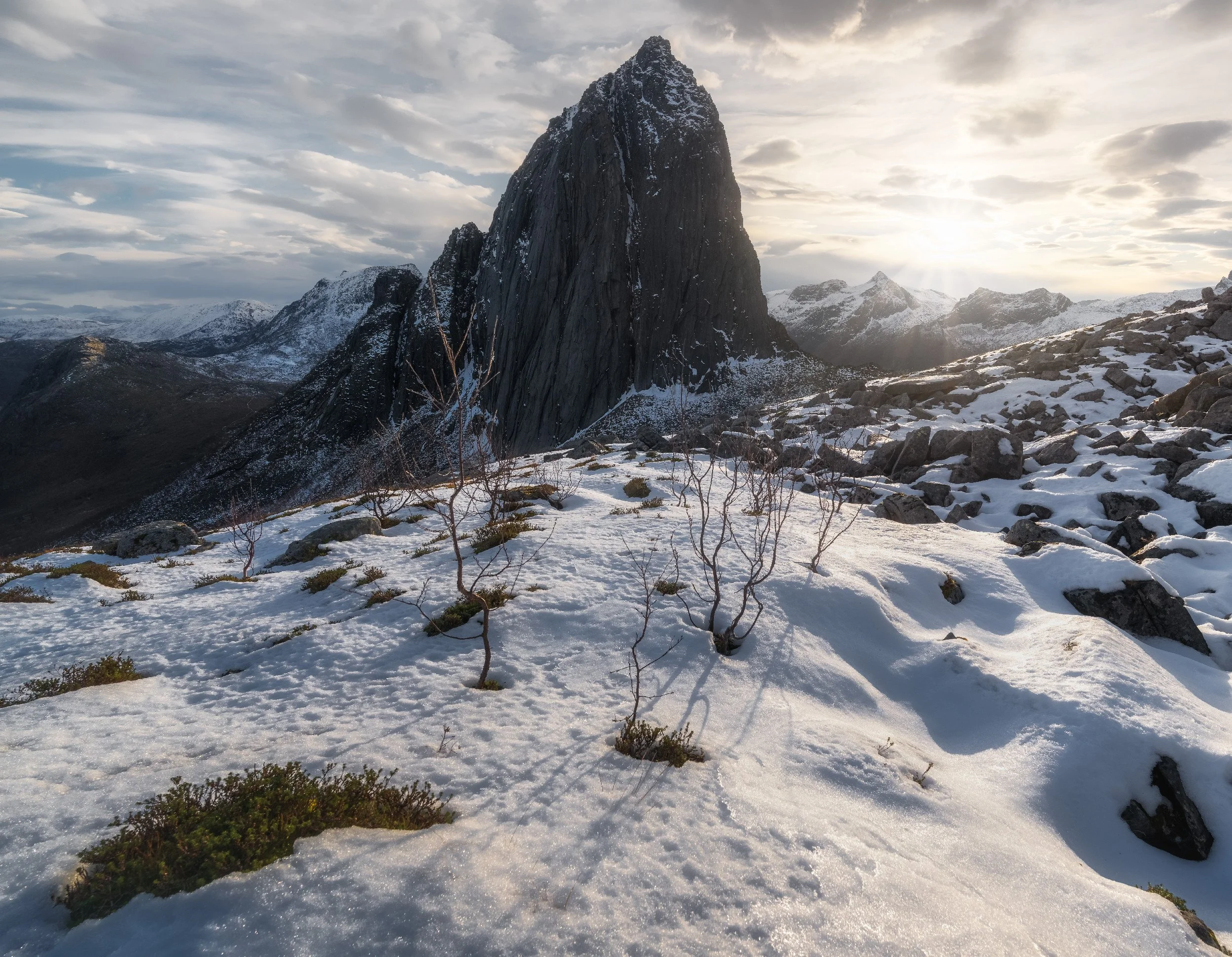
Snowy boulders. looking towards Segla.
We also missed our turning and ended up picking our way across snowy boulder fields off the path, which I can't recommend, but eventually the angle I wanted to shoot Segla slowly came into view, and the moaning stops.
Big sail of rock, sheer cliff dropping away beside you. I extended the selfie stick out over the edge for a look down and my knees, already a bit weak from the climb, fully gave up. It's a long way down. Three hundred metres or so of nothing…
For the photography, this is where you want to work it properly rather than fire one frame and call it. I shot a six-shot handheld HDR panorama to hold the dynamic range and get the full sweep, then sent the drone up for the perspective you simply can't get on foot, looking back along the ridge and down to the water. It was gusty enough to throw a couple of strong wind warnings, and I'll admit to mild terror at the thought of it dropping three hundred metres into the sea, but the footage was worth the nerves. Hands like blocks of ice by this point, gloves and hand warmers deployed, coffee and ham sandwiches as a reward. Taking a moment away from the cameras to soak in the incredible beauty of this location.
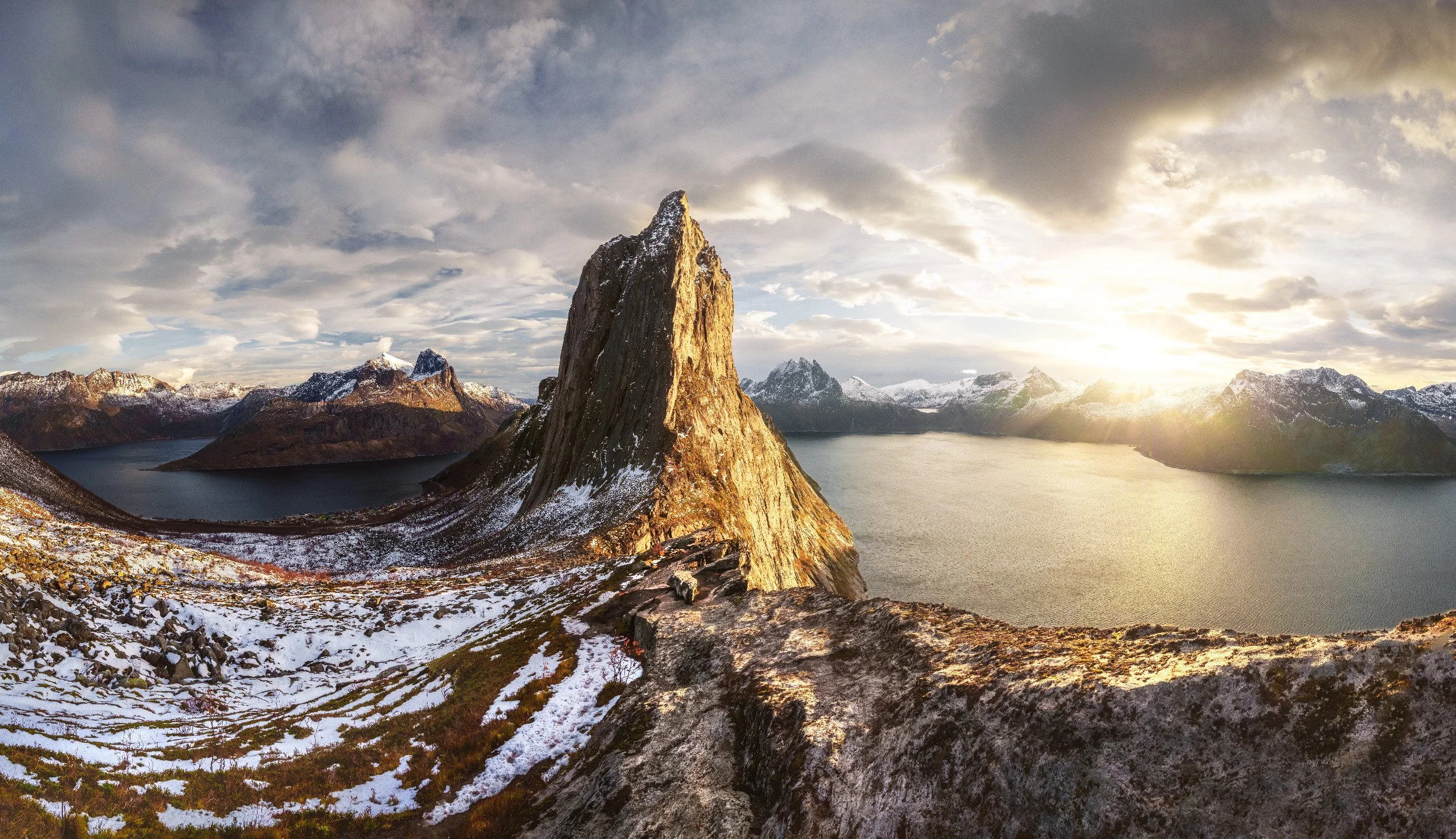
Handheld HDR Pano, Taken from near the cliff edge
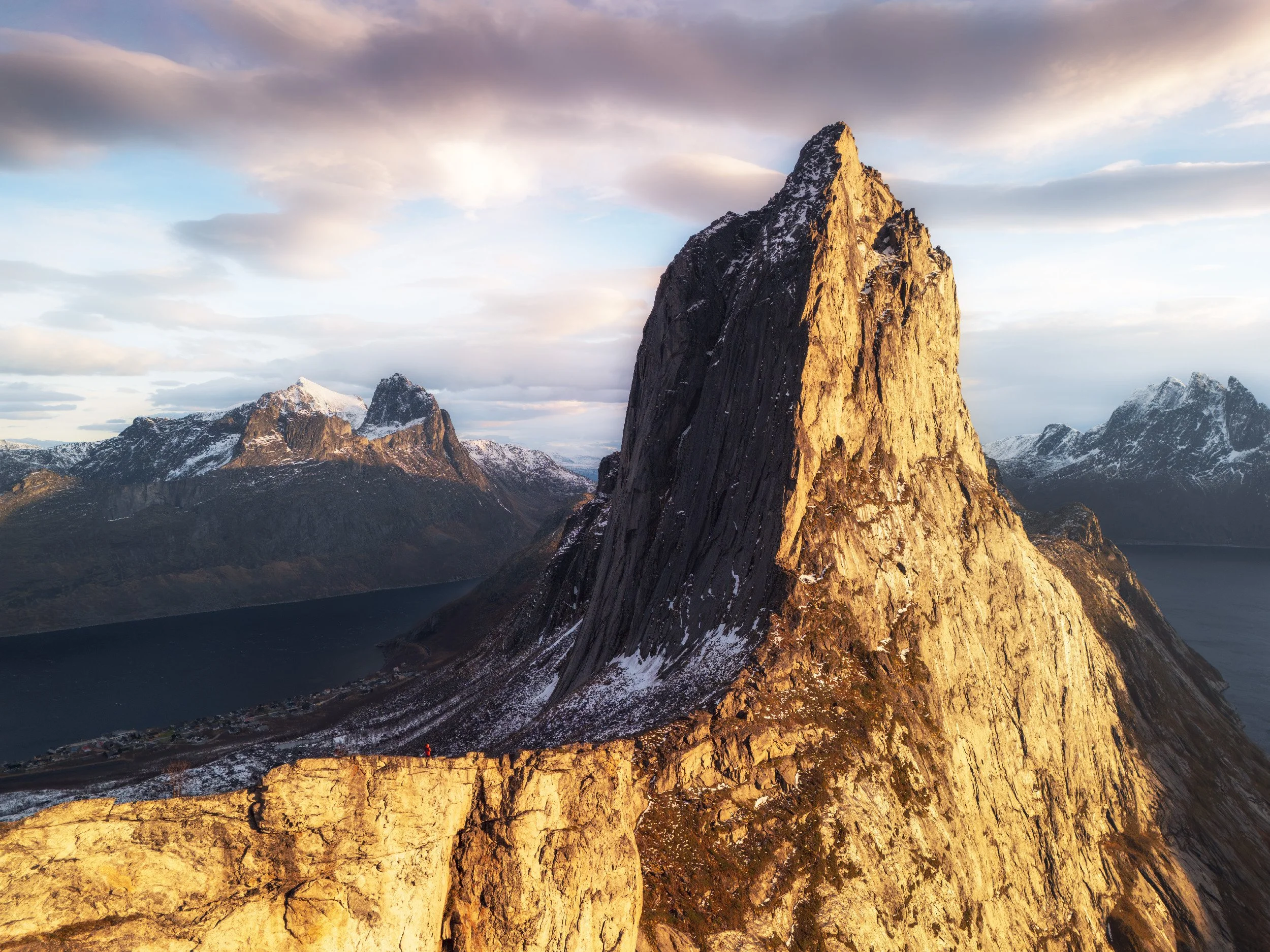
Perspective from above the fjord, you can just about see me in my red jacket
And then the bit you can't plan for. As the sun dipped behind the mountains and we started the slog back down, the sky behind us just went off. Properly exploded with colour. The only sane response was to stop, swear gently, and put the drone straight back up. No way I was hiking back up and then coming back down in the dark! I was way too hungry for shenannigans like that.
WA Pano taken on the drone, looking back towards Segla whilst we were halfway down the trail.
Insane colours, well-timed fishing boats, clouds bursting with evening colour with the low setting Arctic sun. This (above) was probably my favourite shot, not only because of the conditions and colours, but that beautiful leading swoop up the mountain was perfect.
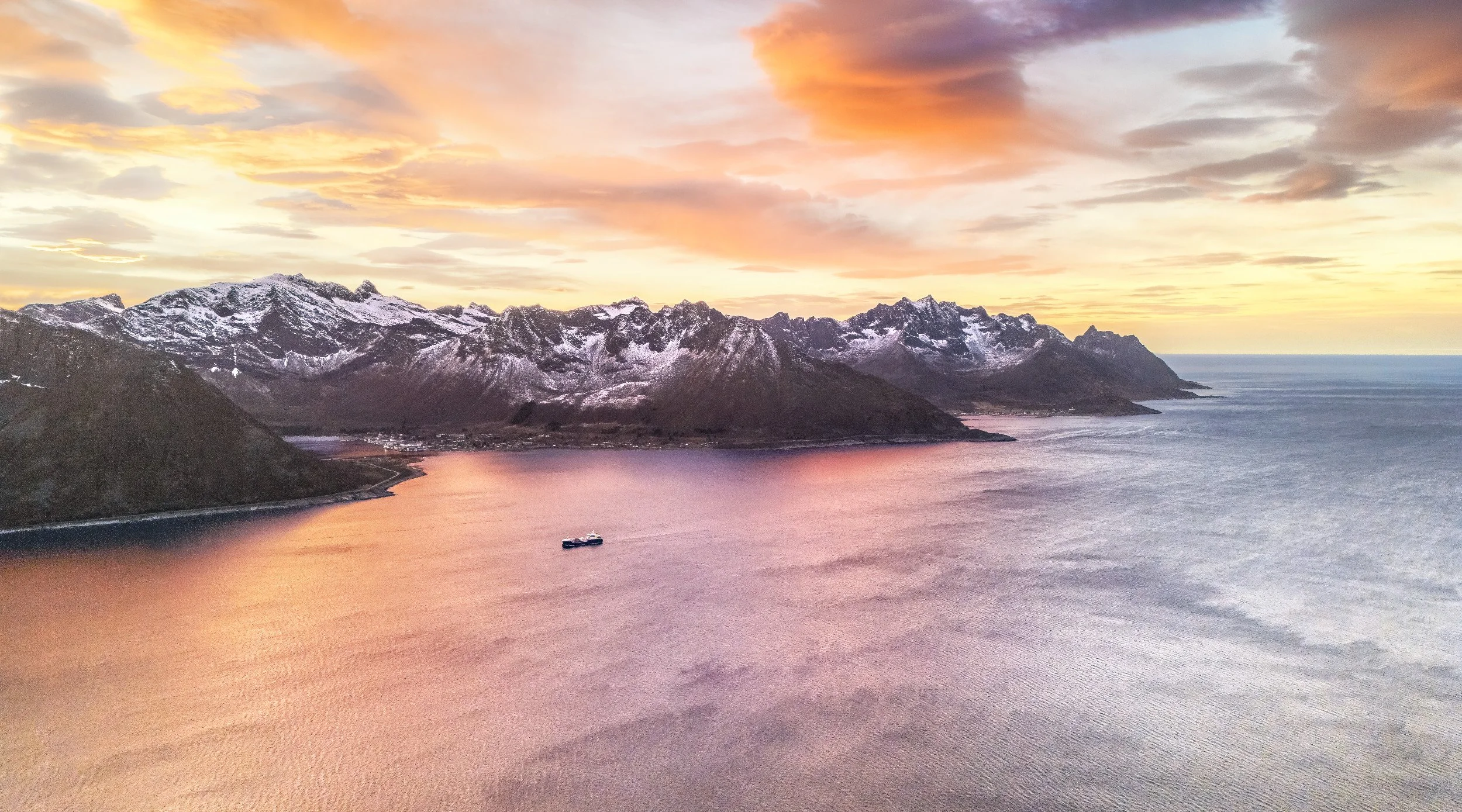
The fire sky and view back towards Senjahopen
Getting to and Hiking Segla/Hesten
I’ve started to use Komoot on the free plan to help me determine whether a hike is going to kill me or not. This is the route we were supposed to take, there was some liberty taken in how we got across to and back from the ridgeline… it’s hard when it’s covered in snow!! That’s my excuse.
We started in the car park, where there are public toilets (A) and then headed back down the road into town to reach the trail head. Then it was just following the path up the valley across the bog and through the trees.
At some point, the path splits and you head left, I think we missed that turn… We made it across, albeit very slowly!
We could have done more up there, but honestly we just enjoyed shooting where we were, and with the winter days shortening rapidly, we want to get up and down in the light.
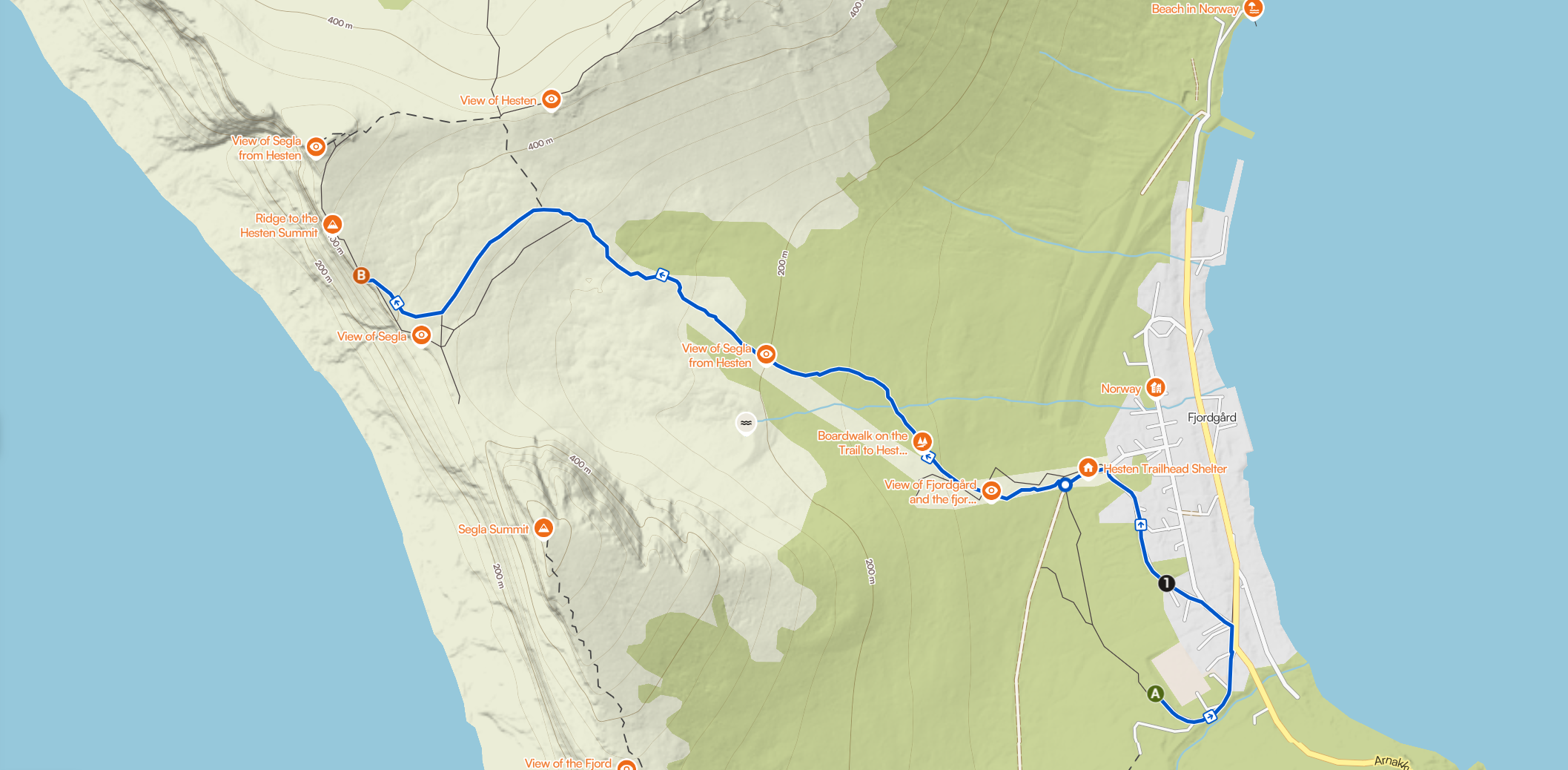
A komoot trail of the route we were supposed to take
What was actually in the bag
Story first, but for the gear-curious: the Sony A7R V did the heavy lifting, mostly on the 16-35mm down low and wide. The drone earned its keep at Hamn and Segla and is close to essential here for reading the fjord layouts and reaching the islands you can't walk to. ND filter and polariser for the fjords.
The Fujifilm X100VI rode along for the off-duty stuff, mostly when Cas was driving and I was shooting from the passenger seat! Spikes, hiking poles and hand warmers for the Hesten hike, both vindicated and highly recommended if you’re going around the winter season.
What's next
We left Senja the next morning and pointed the car south, the first leg of a two day drive down to Lofoten with a stopover in Svolvær, which is where the next chapter of this Arctic Norway road trip picks up. There's a lot more exploring to come, including a leg-busting climb up nearly two thousand steps to Reinebringen, and once we reached the honeypots of Lofoten proper, conditions I had only previously dreamed of having, let alone actually being able to shoot them!! Spoiler, sun + rain = it gets moooody.
If you're plotting the same trip, everything I learned about the seventeen best spots down the E10 lives in my Lofoten photography guide, so you can skip the wrong turns and have a solid plan in your back pocket!
And if you'd rather watch the whole Senja leg unfold, mud, dropped lens hoods, gate-crashing aurora and all, the full video is over on my YouTube channel.
Senja photography FAQ
How do you get to Senja?
Fly into Tromsø, hire a car, and you're a couple of hours away by road plus a short ferry, or you can drive the whole way round. Tromsø is the nearest airport with proper connections. A hire car isn't optional here. The spots are spread right across the island and you'll want the freedom to chase the light.
When is the best time to photograph Senja?
It depends what you're after. We went in November for the broody winter light and a shot at the northern lights, and got about seven hours of daylight with the sun barely clearing the peaks. Brilliant for atmosphere, short on hours. For midnight sun and green landscapes, aim for May to July. For snow, low light and aurora, late autumn through winter. Just go in knowing the daylight maths.
What are the best photography locations on Senja?
The ones that earned their place for us were Tungeneset for the rock pools and the Okshornan ridge, Hamn i Senja for the quiet islands and bridges, the Bergsbotn platform for the fjord view, and Segla, the island's icon, shot from the neighbouring peak of Hesten. Then there are the roadside fjord huts you'll stop for whether you planned to or not.
How hard is the hike to Segla via Hesten?
Moderate, but not to be shrugged off. It's around two kilometres uphill carrying full camera kit, and in winter it's largely mud with icy stretches, so microspikes are worth packing. Allow a couple of hours up and the same care coming down, and check the wind before flying a drone near the edge. The drop off the side is a long one.
Can you see the northern lights on Senja?
Yes. Senja sits well inside the aurora zone and clear winter nights give you a genuine chance. We caught a strong show. The hard part isn't seeing them, it's composing them, so scout a foreground with a strong shape in daylight rather than fumbling for one in the pitch dark. Learn from my mistakes on that front.
Senja or Lofoten, which should you photograph?
Both, ideally, and they're close enough to combine into one trip. Lofoten has the famous, much-photographed honeypots and the crowds that come with them. Senja gives you a lot of the same drama with a fraction of the people, which is exactly why we'd send you there first. If you've only time for one and you want quiet, Senja. If you're chasing the iconic shots, Lofoten.